
Quantum Teleportation: Send a Qubit Without Sending a Qubit
Last updated · 11 min read · ZKSF team

Run this one yourself. The notebook builds the circuit and reads the certificate for the run below, with no account and nothing to install.
The short version
- A state moves and nothing else does. Two classical bits and a shared entangled pair, with no matter transported and no signalling
- Four Bell outcomes, four corrections. Alice's joint measurement has four possible results, each equally likely at probability one quarter
- Bob measured 1 in 741 shots of 1,000. Alice prepared 0.75, and the binomial standard deviation is about 14, so the result sits well within one sigma
- Bob's qubit never interacted with Alice's directly. That is what makes the measured agreement the result rather than a coincidence
Quantum teleportation transfers the complete state of one qubit to another using a shared entangled pair and two classical bits. It is the most misreported result in the field, so it is worth being exact. Nothing travels faster than light, no matter is transported, and the protocol cannot be used for signalling. What moves is a quantum state, and the mechanism is instructive well beyond its own application.
The problem it solves
Two theorems make the obvious approaches unavailable. The no-cloning theorem forbids copying an unknown quantum state, so a state cannot be duplicated and one copy sent. Measurement destroys superposition and returns at most one classical bit per qubit, so an unknown state cannot be read and its description transmitted; a single qubit's state requires two real numbers to specify, and no finite number of measurements on one copy recovers them.
Teleportation resolves this. Alice holds a qubit in an unknown state. Alice and Bob share an entangled pair prepared in advance. Alice performs a joint measurement on her qubit and her half of the pair, obtaining two classical bits, and transmits them to Bob. Bob applies one of four corrections determined by those bits, and his qubit is left in Alice's original state.
Alice's original is necessarily destroyed by her measurement, which is what keeps the protocol consistent with no-cloning. The state has moved rather than been copied.
Why it does not permit faster-than-light signalling
This point is worth settling explicitly, because it is where popular accounts go wrong.
Before Bob applies his correction, his qubit is in a maximally mixed state regardless of what Alice's original was. Its density matrix is the identity divided by two, containing no information whatsoever. Bob cannot distinguish it from a random qubit, and no measurement he performs reveals anything about Alice's state.
The two classical bits are therefore indispensable, and they travel by ordinary means at or below light speed. Entanglement supplies correlation, not communication. This is the content of the no-communication theorem, and teleportation is fully consistent with it.
The circuit
The template lays the protocol out on three qubits. Qubit 0 carries Alice's message, prepared here to read 1 with probability approximately 0.75.
Qubits 1 and 2 are the shared entangled pair. Alice entangles her message with her half of the pair and applies a Hadamard, which together constitute a measurement in the Bell basis.
Bob's two conditional corrections are written here as a CNOT and a controlled-Z so the whole protocol runs as one coherent circuit; on separate hardware these would be classically conditioned operations. Only Bob's qubit is measured.
OPENQASM 2.0;
include "qelib1.inc";
qreg q[3];
creg c[1];
ry(2.0944) q[0];        // Alice's state, ~75% |1>
h q[1];
cx q[1],q[2];           // the shared Bell pair
cx q[0],q[1];
h q[0];                 // Alice's Bell measurement
cx q[1],q[2];           // Bob's X correction
cz q[0],q[2];           // Bob's Z correction
measure q[2] -> c[0];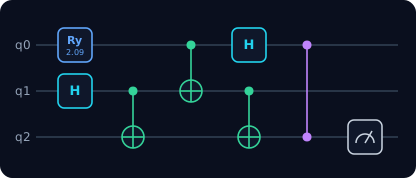
The blue Ry on q0 prepares Alice's state. The Hadamard and CNOT on q1 and q2 build the entangled pair, which is the Phi+ Bell state constructed in the GHZ walkthrough. The middle block is Alice's side; the CNOT and controlled-Z reaching down to q2 are Bob's corrections.
Why there are exactly four corrections
The four Bell states form an orthonormal basis of the two-qubit space, so Alice's joint measurement has four possible outcomes, each equally likely at probability 1/4. Each outcome leaves Bob's qubit in Alice's state acted on by one of four operators: the identity, X, Z, or ZX.
Bob's correction is the inverse of whichever occurred, and since each of these operators is its own inverse, he simply applies the same one. Two classical bits index four cases exactly, which is why the classical channel cost is two bits and not more. The accounting is tight, and this precise correspondence between one qubit, one Bell pair and two classical bits is the standard unit of quantum communication.
A certified run
Alice's qubit was prepared to read 1 with probability 0.75. If the protocol works, Bob's qubit, which never interacted with Alice's directly, should show the same distribution. The circuit was submitted at 1,000 shots on the exact statevector engine.
counts:     {"1": 741, "0": 259}
error_info: {"method": "exact statevector",
             "truncation_error": 0.0,
"shot_noise_only": true, "shots": 1000}It is worth noting what this run does and does not verify. Measuring in the computational basis confirms the probability amplitudes transferred correctly. Confirming that the relative phase also transferred requires measuring in a rotated basis, which is the natural next experiment and a useful exercise: prepare a state on the equator of the Bloch sphere and check that Bob's qubit reproduces it under an X-basis measurement.
Where it is used
Teleportation is not a demonstration piece. It is the transport layer of quantum networking, the mechanism by which distant processors will exchange states, and it underlies entanglement swapping, which is how quantum repeaters extend entanglement beyond the attenuation length of a fibre.
It also appears inside fault-tolerant computation. Gate teleportation applies a gate by teleporting through a specially prepared resource state, and this is how non-Clifford gates such as T are implemented in most fault-tolerant schemes, since they cannot be applied directly on encoded states.
Magic state distillation exists to produce those resource states, and it dominates the cost of fault-tolerant computation. The relationship between Clifford and non-Clifford operations is developed in Clifford circuits and Stim.
Running it
Select Quantum teleportation in the console and run it. Change the Ry angle on Alice's qubit and confirm Bob's distribution follows. Then attempt the phase check described above, which is where the protocol becomes genuinely convincing rather than merely consistent.
Run your own 100-qubit circuit, with an error bar.